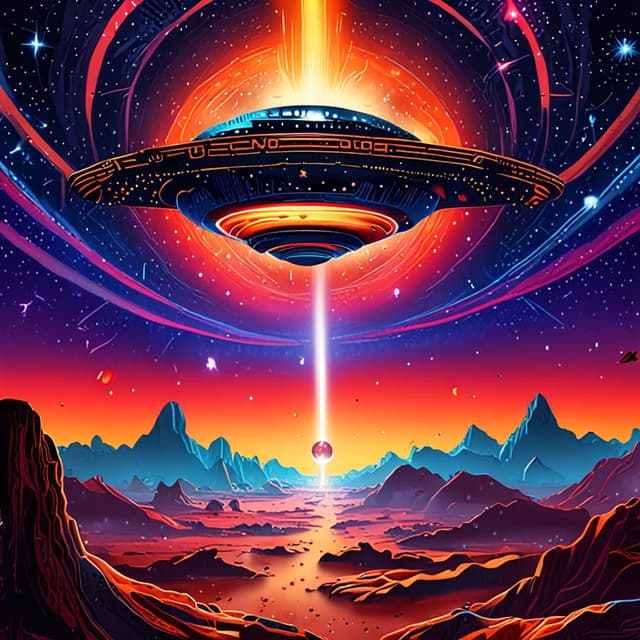
| Genre | Science fiction • Space opera |
| Title | Magellanic Cloud: The Interstellar Frontier |
| Author | Stanisław Lem |
| Series | Magellanic Cloud |
| Themes | Space exploration • First contact • Technological progress • Philosophical and ethical dilemmas |
| Publisher | Wydawnictwo Literackie |
| Sequel to | Magellanic Cloud (1955) |
| Plot summary | Humanity has made significant advances in space exploration and colonization, enabled by breakthroughs in faster-than-light drive technology. This newfound ability allows for the establishment of permanent settlements on distant exoplanets, leading to first contact with a variety of alien civilizations. However, this expansionist phase brings new challenges and threats, both practical and existential, that humanity must navigate. The story explores the philosophical, social, and ethical ramifications of humanity's transformation into a true spacefaring species. |
| Publication date | 2023 |
In Stanisław Lem's 1955 novel Magellanic Cloud, humanity makes first contact with an advanced alien civilization residing in the Magellanic Clouds, two dwarf galaxy companions to our own Milky Way. The story follows a scientific expedition sent to initiate communication and exchange knowledge with this alien race, known as the Solarians.
However, the Solarians prove to be an enigmatic and reclusive people, with a radically different psychology and modes of thinking that confound the human explorers. Despite some successful exchanges, the humans ultimately fail to fully understand or establish meaningful relations with the aliens, leaving the future of contact between the two civilizations uncertain.
In the decades following the events of Magellanic Cloud, human scientists made a series of revolutionary breakthroughs in the field of faster-than-light (FTL) propulsion. Building on the foundational work done during the initial Solarian contact mission, engineers developed practical FTL engines that could propel crewed spacecraft to distant stars at a significant fraction of the speed of light.
These new FTL drives, based on advances in quantum mechanics, gravitational manipulation, and theoretical physics, ushered in a new era of space exploration and colonization for humanity. No longer constrained by the vast distances between stars, human civilization could now establish permanent settlements on exoplanets orbiting distant suns.
With the capability to rapidly traverse the galaxy, humanity rapidly expanded its presence beyond the confines of the Sol system. Dozens of interstellar colony ships, housing thousands of settlers each, were launched to establish permanent human settlements on carefully selected worlds.
These new colonies, located light-years from Earth, were self-sustaining and capable of reproducing and growing their populations over multiple generations. They developed unique cultural identities while maintaining strong ties to their mother civilization. Key colony worlds included Kepler-186f, Gliese 667Cc, and Proxima Centauri b.
With humanity's newfound ability to rapidly explore and colonize distant star systems, it was only a matter of time before the expanding human presence came into contact with other intelligent species in the Milky Way galaxy. These first encounters proved both exciting and challenging, as humanity grappled with the reality of sharing the cosmos with other technological civilizations.
Some alien species, such as the Zyrothans and the Gremaldi, proved receptive to diplomatic relations and cultural exchange with humans. Others, like the aggressive Xonon empire, viewed the human expansion as a threat and responded with hostility. Navigating these complex geopolitical dynamics became a major focus for human leaders, even as they continued to grow their interstellar domain.
As the network of human colonies expanded to encompass dozens of systems, new governance challenges arose. Coordinating economic, social, and defense policies across light-years of distance tested the limits of traditional governing structures. Competing visions emerged for how best to administer and unify this sprawling interstellar human civilization.
Some advocated for a centralized, totalitarian approach to maintain order and cohesion. Others pushed for a more decentralized, confederate model that granted greater autonomy to individual colonies. Heated debates erupted over the role of artificial intelligence, existential risks, and the moral obligations of a spacefaring species. These philosophical and practical challenges would come to a head in the climactic events to come.
The rapid progress of human civilization into the stars raised profound questions about the nature of our species and its place in the universe. Were we alone, or would continued expansion lead to further encounters and even conflicts with alien civilizations? What were the ethical implications of claiming ownership over distant worlds? And did humanity have a unique destiny among the cosmos, or were we simply one of many technological species vying for survival and supremacy?
As humans grappled with these weighty philosophical and existential questions, the future of our species hung in the balance. The choices made in the coming years would determine whether humanity would rise to the challenges of becoming a true spacefaring civilization, or succumb to the dangers and contradictions inherent in such cosmic ambitions. The path forward was uncharted, but the promise of the stars beckoned ever brighter.
